Home › Services › Hardboard Siding Replacement
On many houses from the 1980s and 1990s, the lap siding on the upper story, the gables and the back wall is hardboard: wood fiber pressed with resin. Painted and sealed it holds up. Once water gets into an edge, it swells and does not come back.
Hardboard fails where water sits. The lower drip edge of each board absorbs water if the paint has worn; the board swells, the paint cracks, and the edge flares out or “mushrooms.” Butt joints, where two boards meet end to end, take in water the same way. Over-driven nails break the surface and let it in from the face.
In Cypress the usual accelerant is a lawn sprinkler hitting the wall every morning, or a flower bed built up against the siding. The lowest courses of the back wall, next to the sprinkler heads, are often the worst.
Hardboard lap siding was era-typical on production homes of the late 1970s through the 1990s across the Houston area, which covers much of Copperfield, Fairfield, Longwood and Coles Crossing. That is a statement about the era, not about any particular house: builders varied, and many owners have already replaced it. The quickest check is to look at a lower board edge on a shaded wall. Copperfield · Fairfield
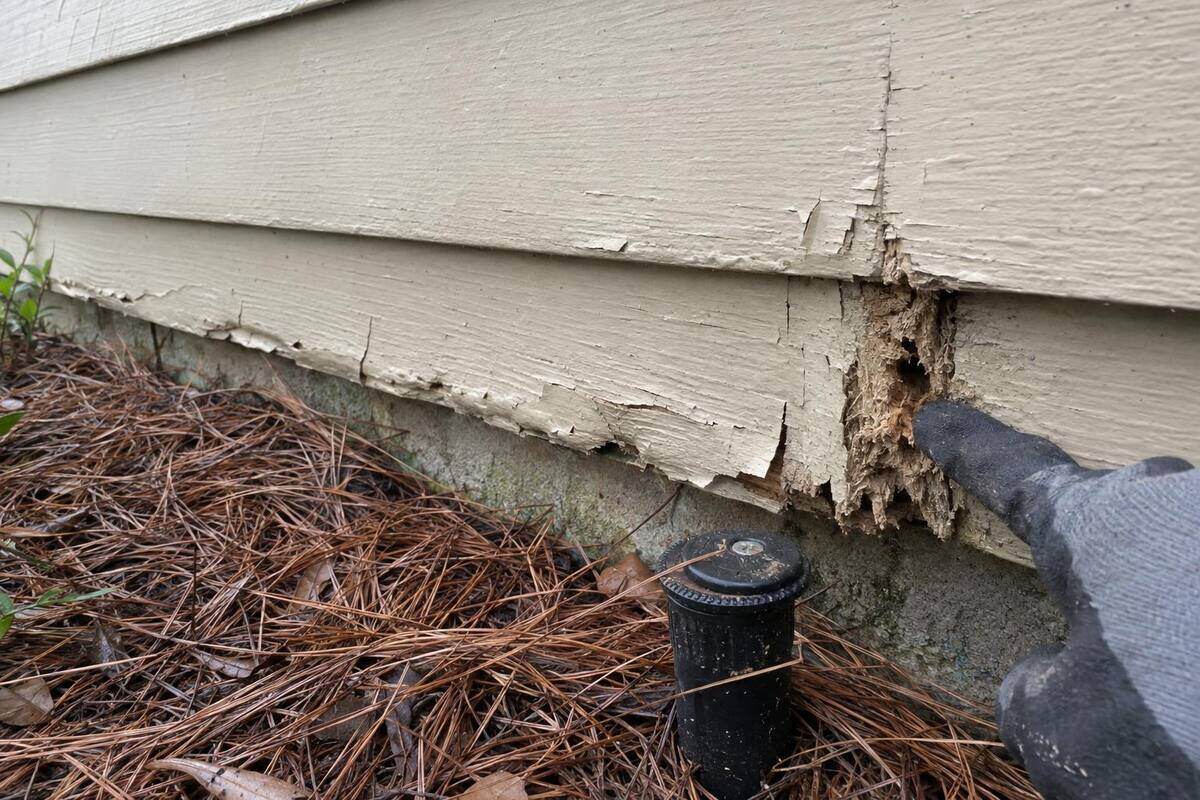
If damage is limited to a few boards and the rest are sound and painted, replacing those boards is a reasonable repair. The catch is matching: hardboard of the same profile is harder to find than it used to be, and a replacement board of a different material can read differently once painted.
When swelling runs along whole walls, the usual answer is to replace the siding on the affected elevations, or the whole house, with fiber cement. That is also the moment to replace the house wrap and flashing around windows, which have often failed along with the siding. Fiber-cement replacement
The replacement material and profile, how much wall will be opened, how rotted sheathing or framing behind the siding will be handled and priced, the trim and flashing plan, and whether painting is included. Then the ACC gets the material and color.
Tell the contractor which walls are affected and roughly when the house was built.
 Cypress Roofing